The SEEN Model™ [S]: Why Buyers Can’t Place You in 5 Seconds

Part 2 of 5 in The SEEN Model™ Series | Authority Insights
Missed Part 1? Start here: You’re Not Being Passed Over. You’re Being Misread.
Casey had been a CFO for 18 years. He had left corporate, built a fractional practice, and had the track record to be operating at the highest level.
On a call last year he was introduced as “a finance consultant who can help clean things up.”
Nothing in his positioning had clarified — in the seconds before anyone spoke — that he operated at CFO level. So the buyer filled the gap and got it wrong.
That’s the S problem. And it’s the first place the signal breaks.
What Specific Authority Signal Actually Means
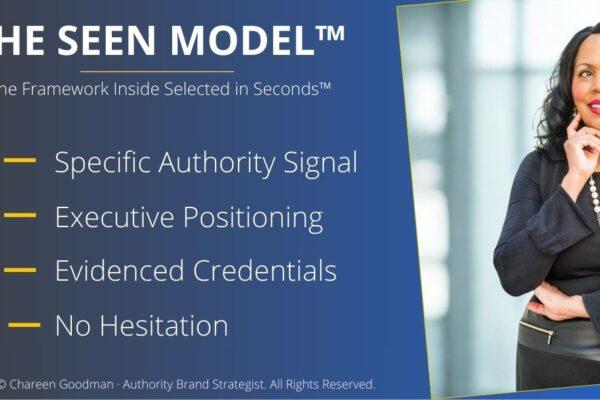
The S in the SEEN Model™ stands for Specific Authority Signal and it answers one question:
In five seconds, can a buyer tell what lane you own, what level you operate at, and who you’re built to lead?
Buyers need to answer three questions almost instantly:
- What level do you operate at?
- What do you specialize in?
- Who do you serve?
When this is working, the answers are immediate. “Fractional CFO for PE-backed companies scaling $20M–$150M” answers all three without a moment’s pause or mental friction.
When it’s broken, the signal is generic. “Finance & Operations Leader | Helping companies improve performance” tells a buyer almost nothing.
- The level is unclear.
- The domain is broad.
- The audience is undefined.
The buyer’s brain searches for a category to place you in… and finding none, assigns one. Usually lower than you deserve.
Why Fractional Executives Are Especially Vulnerable to This Problem
When you were inside a company, your title did most of this work for you. “CFO, [Company Name]” answered all three questions instantly.
Level — C-suite.
Domain — finance.
Audience — the company.
When you went independent, that shortcut disappeared. Now you have to build the authority signal from scratch in a headline, an About section, an introduction, a positioning statement.
And most fractional executives do this by describing what they can do rather than declaring who they are and at what level.
The result is a profile that reads like a list of capabilities rather than an authority signal.
This approach of listing capabilities gets you placed as a resource, not a senior level peer.
What a Broken Specific Authority Signal Looks Like
These are the patterns I see most often:
The generalist signal. The domain is too broad to place. “Operations and strategy leader” could describe anyone from a project manager to a COO. The buyer can’t place you in five seconds so they place you at the lower to avoid risk.
The helper signal. The language centers on what you can do for someone rather than what level you operate at. “Helping companies improve performance” signals support, not leadership. Buyers read that and think resource, not executive.
The title mismatch. Your headline says “Consultant” or “Advisor” but your track record says CFO, COO, CMO. The title is doing damage before anyone reads a single word of your bio.
The pivot that isn’t explained. You’ve moved from one domain to another and the profile shows both without explaining the through-line. Buyers see complexity where they need to see clarity.
What a Working Specific Authority Signal Looks Like
It is precise. It is declarative. It answers all three questions without requiring the buyer to do any mental work.
“Fractional CFO for PE-backed companies scaling $20M–$150M” — level, domain, audience. Instant.
“Interim CMO | B2B SaaS | Revenue-stage growth to Series B” — level, domain, audience. Instant.
“Fractional COO for founder-led professional services firms ready to scale without breaking” — level, domain, audience. Instant.
Notice what these don’t say.
- They don’t say “helping.”
- They don’t say “consulting.”
- They don’t list capabilities.
They declare a level, a domain, and an audience and they do it in one line… the Specific Authority Signal.
The Diagnostic Question
Here is the question I ask every client when we look at their Specific Authority Signal:
If a buyer spent five seconds on your headline and moved on, what level would they assume you operate at?
Not what level you are. What level they would assume based on what they read.
If the answer is anything less than the level you actually operate at, the S element of your SEEN Model™ is broken. And that break is happening before anyone reads your bio, before they hear you speak, before they ask a single question.
Next in the series: [E] Executive Positioning — Why the Language of Doing Is Costing You Strategic Mandates
The good news is that Specific Authority Signal is one of the most correctable elements in the entire model. One precise rewrite of your headline and positioning statement can shift the assumption immediately.
The Selected in Seconds Authority Scan identifies exactly where your Specific Authority Signal is breaking down and what to correct so buyers place you correctly from the first glance.
→ Read the Selected in Seconds Authority Brief — FREE
Chareen Goodman | Authority Brand Strategist | Creator of the SEEN Model™ and Selected in Seconds™ Framework | Authority Brand Studio™

© Chareen Goodman. All rights reserved. SEEN Model™ and Selected in Seconds™ are trademarks of Chareen Goodman.