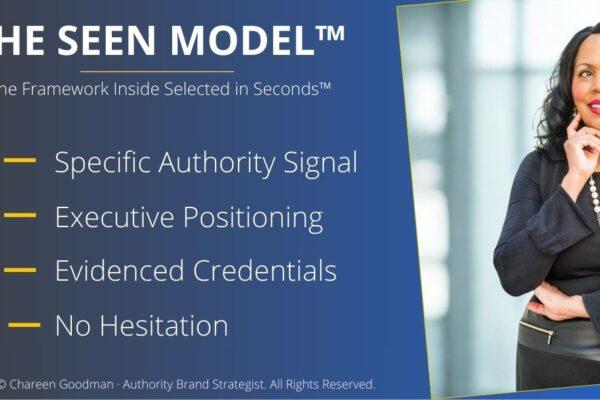
The SEEN Model™ [E]: Why Impressive Without Proof Doesn’t Close Retainers

Part 4 of 5 in The SEEN Model™ Series | Authority Insights | Authority Brand Studio™
Missed the series? Start with Part 1: You’re Not Being Passed Over. You’re Being Misread.
David kept being brought in after strategy was already decided. Fixing execution problems instead of shaping direction. Serving more as a day-rate consultant instead of a retained fractional CRO, and he just couldn’t figure out why.
His strategic credentials were solid. But they were also invisible.
That’s the second E problem in the SEEN Model™. And it’s the one that keeps highly qualified fractional executives operating one tier below where they should.
This isn’t caused by a lack of proof. It because their proof isn’t showing up where buyers can see it.
What Evidenced Credentials Actually Means
The second E in the SEEN Model™ stands for Evidenced Credentials and it answers one question:
Can a buyer confirm your executive-level authority in the first 5 seconds without having to ask?
Claims without evidence create hesitation. Fast-read credibility markers — company names, scale metrics, strategic outcomes, recognizable achievements — are what allow a buyer to confirm your level instantly.
The difference between a claim and a credential is the difference between telling a buyer you’re at the right level and showing them proof they can evaluate immediately.
The Four Types of Evidence That Create Instant Credibility
Company names at scale. Working with recognizable organizations or companies of significant size signals the level at which you’ve operated. “Former VP Sales, Oracle” lands differently than “senior sales leader.” The company name does the confirmation work so the buyer doesn’t have to.
Scale metrics. Numbers are the fastest credibility shortcut available to a fractional executive. “Built a $200M revenue organization” lands differently than “extensive revenue experience.” The number confirms the level. Without it, “extensive” means whatever the buyer decides it means and buyers default to conservative assumptions.
Outcome language at executive scale. “Led three PE-backed exits” lands differently than “familiar with private equity environments.” One describes something that happened at a specific level. The other describes a familiarity that could belong to anyone.
Strategic scope markers. Board presentations. P&L ownership. Cross-functional leadership. M&A involvement. These are the markers that signal decision-level authority and they need to be visible in the first scan, not buried in a bullet point at the bottom of your experience section.
What Happened to David
David’s profile described his expertise accurately. What it didn’t do was make that expertise immediately visible to a buyer scanning his profile in five seconds.
The board-level initiatives were there, but described in consulting language that didn’t signal their strategic significance to the buyer.
The transformational outcomes were there, but neatly buried under process language that made them sound like daily execution rather than strategic leadership.
The decisions he had owned were there, but framed as roles & responsibilities rather than business-impact results.
Once we surfaced the board-level initiatives with clear outcome language, made the transformational results visible at the top of his profile, and reframed his ownership decisions in terms of organizational impact buyers paid attention in a different way.
They started bringing him into conversations before direction was finalized. Before strategy was set. At the level where his actual contribution could happen.
Same experience. Finally visible.
The Most Common Evidenced Credentials Mistakes
Burying the best proof. The most impressive, most credibility-confirming credential is often in the third paragraph or the fifth bullet point. By the time a buyer gets there they’ve already formed an impression and first impressions in rapid evaluation are extremely resistant to revision.
Using internal language for external audiences. Job titles and project names that made perfect sense inside your company often mean nothing to buyers outside it. “Led Project Apex” tells a buyer nothing. “Led the operational restructuring that reduced delivery costs by 34% across a $180M business unit” tells them everything.
Listing responsibilities instead of outcomes. Responsibilities describe what you were supposed to do. Outcomes describe what actually happened. Buyers are buying outcomes. If your credentials describe responsibilities you are leaving the most important evidence off the page.
Assuming the buyer will connect the dots. They won’t. Not in five seconds. If the connection between your experience and the level at which you should be operating isn’t explicit and immediate — the buyer will make their own connection. And it will almost always be more conservative than the truth.
The Diagnostic Question
Look at your three most impressive credentials. Ideally the ones that most clearly demonstrate the level at which you’ve operated.
Then ask:
If a buyer saw only these three things and nothing else — would they know with certainty that I operate at the executive level?
Next in the series — the final post: [N] No Hesitation — The Element That Either Closes the Gap or Widens It
If the answer is anything less than an immediate yes, the second E element of your SEEN Model™ is broken.
That means, the proof exists. It’s just not showing up where buyers can see it.
The Selected in Seconds Authority Scan identifies your Specific Authority Signal that is causing failure to your Evidenced Credentials.

© Chareen Goodman. All rights reserved. SEEN Model™ and Selected in Seconds™ are trademarks of Chareen Goodman.