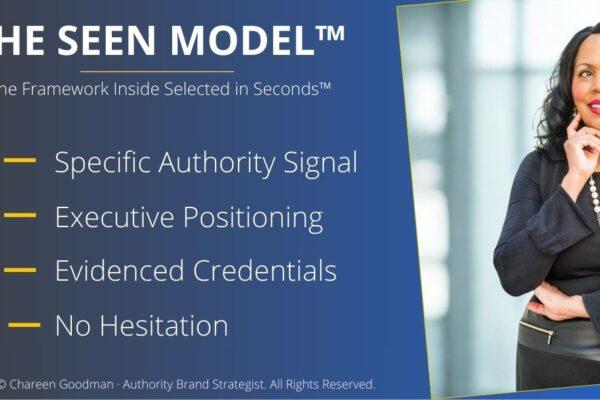
The SEEN Model™ [E]: Why the Language of Doing Is Costing You Strategic Mandates

Part 3 of 5 in The SEEN Model™ Series | Authority Insights
Missed the series? Start with Part 1: You’re Not Being Passed Over. You’re Being Misread.
A call with a potential client went well. They liked him. They said he was “impressive.”
The follow-up email asked for a short-term project proposal instead of the advisory retainer he expected.
Let’s call him Marcus. He knew something had shifted. But he couldn’t identify when or where.
This is the E problem. And it’s the one that stings the most when you finally see it.
What Executive Positioning Actually Means
The first E in the SEEN Model™ stands for Executive Positioning, and it answers one question:
Does your positioning signal that you lead outcomes or that you perform tasks?
This is the element I see broken most often in fractional executive profiles. And it’s the one that creates the most painful misreads because the person is clearly capable, clearly experienced, and clearly operating at a high level. They just don’t sound like it on the page.
The language of doing is not the language of leading.
When your positioning describes tasks you can perform, processes you can improve, ways you can “help” you are signaling support, not ownership. Buyers take that signal at face value and place you accordingly.
What Happened to Marcus
Marcus’s About section described tasks he could perform. He sounded capable. But he did not sound indispensable.
He described what he could do. Not what he had led. Not what he had owned. Not the scale at which decisions he made had moved organizations.
The buyer liked him, but placed him as a capable resource rather than a strategic partner. Hence the project proposal instead of the retainer conversation.
The moment we reframed his positioning around outcomes he led, decisions he owned, and revenue impact at scale the nature of the inquiries changed entirely.
The next conversation opened with strategic questions about growth direction. No short-term project proposal. No scope justification. No rate negotiation.
The work didn’t change. The signal did. He was placed correctly.
The Specific Language Patterns That Create the Problem
“I help companies…” — helper language. Signals support, not leadership.
“I work with organizations to improve…” — process language. Signals execution, not strategy.
“I have experience in…” — capability language. Signals what you can do, not what you’ve owned.
None of these are wrong in isolation. Together they create a positioning profile that reads as highly capable support rather than decision-level leadership.
What Executive Positioning Language Looks Like
The shift is from what you do to what you lead, own, and drive.
Instead of: “I help companies improve their financial operations” Try: “I lead financial transformation for PE-backed companies navigating growth, restructuring, or acquisition”
Instead of: “I work with leadership teams to improve go-to-market strategy” Try: “I own revenue architecture from market positioning through pipeline design for B2B companies scaling to Series B and beyond”
Notice the shift. Ownership. Scale. Outcomes. Decisions led. Not tasks performed.
Why This Is Especially Hard for Fractional Executives
When you were inside a company your title implied the ownership. “COO” meant you owned operations. You didn’t have to say it… the title said it for you.
As a fractional executive you’re often cautious about claiming the same level of ownership because the engagement is part-time or project-based. So the language softens. “I support,” “I assist,” “I help.”
That caution is costing you the mandates you’re qualified for.
The level of the engagement doesn’t change the level at which you operate. If you are bringing COO-level thinking, decision-making, and outcomes to an organization — even fractionally — your positioning should reflect that without apology.
The Diagnostic Question
Read your About section or your positioning statement out loud. Then ask:
Does this sound like someone who leads or someone who supports?
If the honest answer is “supports” — the E element of your SEEN Model™ is broken. And it is breaking the signal at the exact moment buyers are deciding whether to bring you in at the strategic level or the execution level.
Next in the series: [E] Evidenced Credentials — Why Impressive Without Proof Doesn’t Close Retainers
The correction is not about sounding more impressive. It is about accurately reflecting the level at which you actually operate.
The Selected in Seconds Authority Scan identifies exactly where your Executive Positioning is breaking down and what to correct so buyers place you at the strategic level from the first glance.

© Chareen Goodman. All rights reserved. SEEN Model™ and Selected in Seconds™ are trademarks of Chareen Goodman.